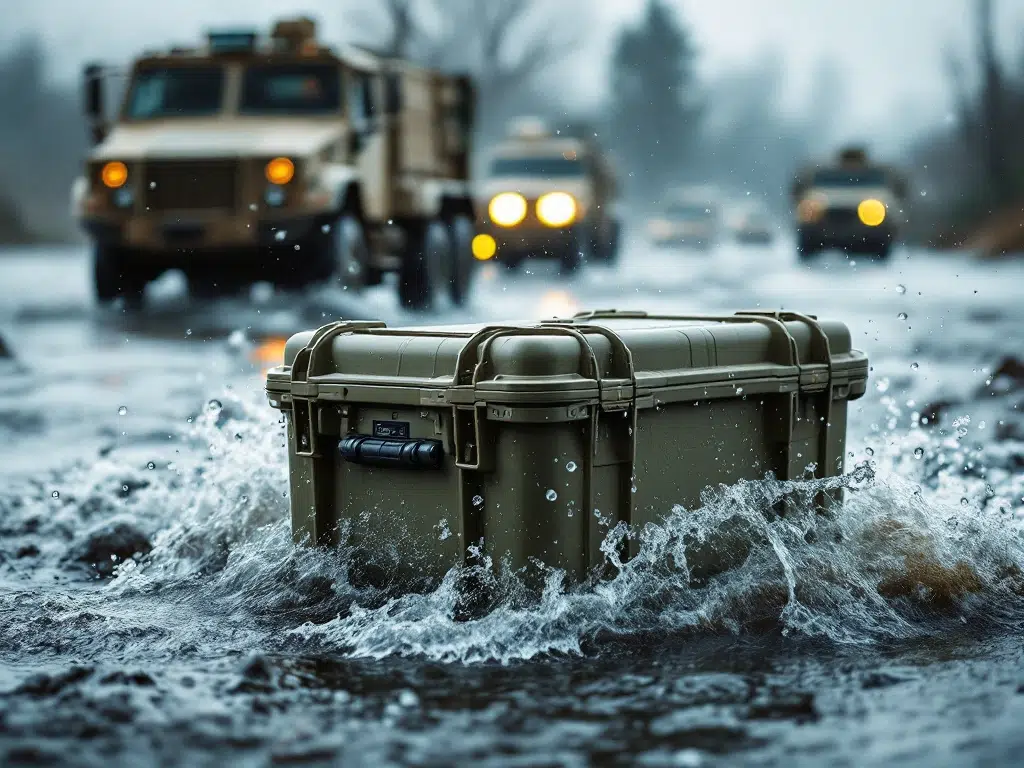
The water resistance of military equipment is a crucial aspect for operational effectiveness and material reliability. Military equipment must function under the most extreme conditions, from desert heat to arctic cold, and from deep submersion to exposure to heavy rainfall. The proper water resistance standards ensure that vital equipment remains operational, regardless of the environmental conditions that military personnel face.
What do IP ratings mean for military water resistance?
IP ratings (International Protection Marking) form a standardized system that indicates the degree of protection against the ingress of solid objects (first digit) and water (second digit). For military applications, particularly the water resistance digits (second number) are important, ranging from 0 (no protection) to 9K (protection against high-pressure water jets).
The IP system works as follows for water resistance:
- IPX0: No protection against water
- IPX1-IPX3: Protection against dripping water and light rainfall
- IPX4: Protection against splashing water from all directions
- IPX5-IPX6: Protection against water jets
- IPX7: Protection against temporary immersion (up to 1 meter, 30 minutes)
- IPX8: Protection against prolonged immersion (deeper than 1 meter)
- IPX9K: Protection against high-pressure water jets
For military applications, the following minimum IP ratings are typically required:
- Standard field equipment: minimum IPX4 (protection against splashing water)
- Communication equipment: minimum IPX5-IPX6 (protection against water jets)
- Maritime and amphibious equipment: minimum IPX7-IPX8 (immersion resistant)
- Special operations equipment: often IPX8 or higher
These classifications are important because they provide a standardized way to compare and specify the water resistance of various equipment, which is essential for procurement and equipment management within defense organizations.
How do MIL-STD-810 water resistance tests differ from commercial standards?
MIL-STD-810 is a United States military standard that describes the methodology for testing military equipment under various environmental conditions, including water resistance. This standard is significantly more stringent than commercial standards and tests equipment under realistic and extreme conditions.
The key differences between MIL-STD-810 water resistance tests and commercial standards are:
| Aspect |
MIL-STD-810 |
Commercial Standards |
| Test duration |
Prolonged exposure (often multiple cycles of 30+ minutes) |
Shorter test periods (often just a few minutes) |
| Immersion depth |
Varying from 1 meter to 20+ meters, depending on the specification |
Usually limited to 1-2 meters |
| Pressure resistance |
Test under increased pressure simulating depth conditions |
Often limited or no pressure resistance testing |
| Temperature variations |
Tests with water of various temperatures (including extremely cold/warm) |
Usually tests at room temperature |
| Functionality test |
Equipment must remain functional during and after exposure |
Often only testing water tightness, not functionality |
| Realistic conditions |
Simulates rain, immersion, splashing water and pressure in combination |
Often tests only one aspect of water resistance |
MIL-STD-810 includes specific test methods such as:
- Method 506.6: Rain tests (including downpours and wind-driven rain)
- Method 512.6: Immersion tests (various depths and pressure)
- Method 514.7: Vibration and water resistance tests combined
These test methods are designed to simulate the extreme conditions that military equipment may encounter in the field, providing a much higher guarantee of reliability than commercial standards.
What water resistance requirements apply to different military environments?
Military operations take place in diverse environments, each with its own challenges regarding water resistance. The requirements therefore vary significantly by deployment area:
Jungle/tropical environments
In jungle environments, the combination of high humidity, intense rainfall, and river crossings presents a challenge for military equipment.
- Requires minimum IPX5-IPX6 classification for standard equipment
- Protection against mold formation and corrosion due to moisture
- Materials must be resistant to prolonged exposure to moisture
- Special seals that work at high temperatures and humidity
Desert environments
Although deserts seem dry, sudden floods and condensation due to temperature fluctuations can cause problems.
- Minimum IPX4 classification for protection against incidental water
- Sand and water-resistant seals (combination IP6X and IPX4)
- Materials that withstand extreme temperature differences
- Protection against condensation during temperature fluctuations
Arctic environments
In arctic areas, snow, ice, and condensation during temperature changes pose the greatest challenges.
- Minimum IPX5 classification for meltwater and snow
- Special seals that remain flexible in extreme cold
- Materials that do not become brittle at low temperatures
- Protection against ice formation in and around seals
Maritime and amphibious operations
These operations place the highest demands on water resistance, with prolonged exposure to salt water and high pressure.
- Minimum IPX7-IPX8 classification for immersion
- Corrosion-resistant materials for saltwater environments
- Pressure-resistant seals for operations at depth
- Protection against hydrostatic pressure during prolonged immersion
For all environments, military equipment often must meet multiple standards simultaneously, such as the combination of water resistance with shock resistance, temperature resistance, and protection against chemical substances. This makes developing suitable packaging and protection solutions for military applications a complex challenge.
Why is water resistance certification crucial for military logistics?
Water resistance certification is not just a technical requirement but has a direct impact on the operational effectiveness, reliability, and logistical costs of defense organizations.
The main reasons why this certification is so important:
Operational reliability
Military missions cannot be postponed due to weather conditions. Equipment must function under all circumstances:
- Communication systems must continue to work during heavy rainfall
- Weapon systems must be reliable after river crossings
- Optical systems must remain clear despite moisture and condensation
- Electronic components must remain protected against short circuits
Material lifespan and maintenance costs
Insufficient water resistance leads to accelerated wear, corrosion, and defects:
- Water ingress causes corrosion of metal components
- Electronic systems are damaged by moisture-related short circuits
- Optical systems are affected by mold and condensation
- Mechanical systems fail due to rust and material weakening
This results in higher maintenance frequency, more spare parts, and shorter lifespan of expensive equipment.
Logistical challenges
The transport and storage of military equipment brings specific water resistance requirements:
- Equipment must be protected during sea transport
- Storage in field conditions requires protection against weather influences
- Air drops and parachute operations expose equipment to extreme conditions
- International deployment means exposure to diverse climate conditions
Certified water-resistant packaging and containers are therefore essential to ensure that equipment arrives at the destination in optimal condition, regardless of the transport method or environmental conditions.
Certification process and standards
The certification process for water resistance of military equipment typically includes:
- Detailed test protocols in accordance with MIL-STD-810 or comparable standards
- Independent verification by certified testing laboratories
- Documentation of test results for procurement and quality control
- Periodic retests to ensure continued compliance
This certification is not just a technical formality but a critical factor in decision-making regarding equipment acquisition, logistical planning, and operational readiness.
For defense organizations looking for reliable packaging solutions that meet the highest water resistance requirements, it is important to work with partners who understand the specific challenges of military applications. At Faes, we understand the unique requirements of the defense sector and develop packaging solutions for defense that meet the strictest water resistance standards, ensuring your equipment always remains safe and operational, regardless of the circumstances.
Frequently Asked Questions
How can I determine the right IP classification for my specific military application?
Start by analyzing the operational environment and potential exposure risks. Identify whether your equipment is primarily exposed to rain, splashing water, or complete immersion. Also consider the frequency and duration of exposure. For field equipment, a minimum of IPX4 is needed, communication equipment requires IPX5-IPX6, and for maritime applications, IPX7-IPX8 is essential. Consult a specialist in military packaging for a final assessment based on your specific deployment scenarios.
What are the most common mistakes when protecting military equipment against water ingress?
The most common mistakes are: underestimating the cumulative effects of moisture over time, neglecting seals and gaskets during maintenance, insufficient attention to cable entries and connectors, and ignoring temperature differences that cause condensation. It's also often forgotten that water resistance decreases after mechanical shocks or vibrations. Therefore, implement a regular inspection protocol for seals and test equipment periodically for water resistance, especially after intensive use in the field.
How does salt water affect water resistance requirements compared to fresh water?
Salt water places significantly higher demands on water resistance due to three important factors: the increased risk of corrosion from salt deposits, the higher electrical conductivity which increases the risk of short circuits, and the surface tension which allows better penetration into small openings. For maritime applications, therefore, not only higher IP classifications (minimum IPX7-IPX8) are needed, but also specific materials that are resistant to salt corrosion, such as certain stainless steel grades, special coatings, and anodized aluminum. Also ensure thorough rinsing procedures with fresh water after exposure to salt water.