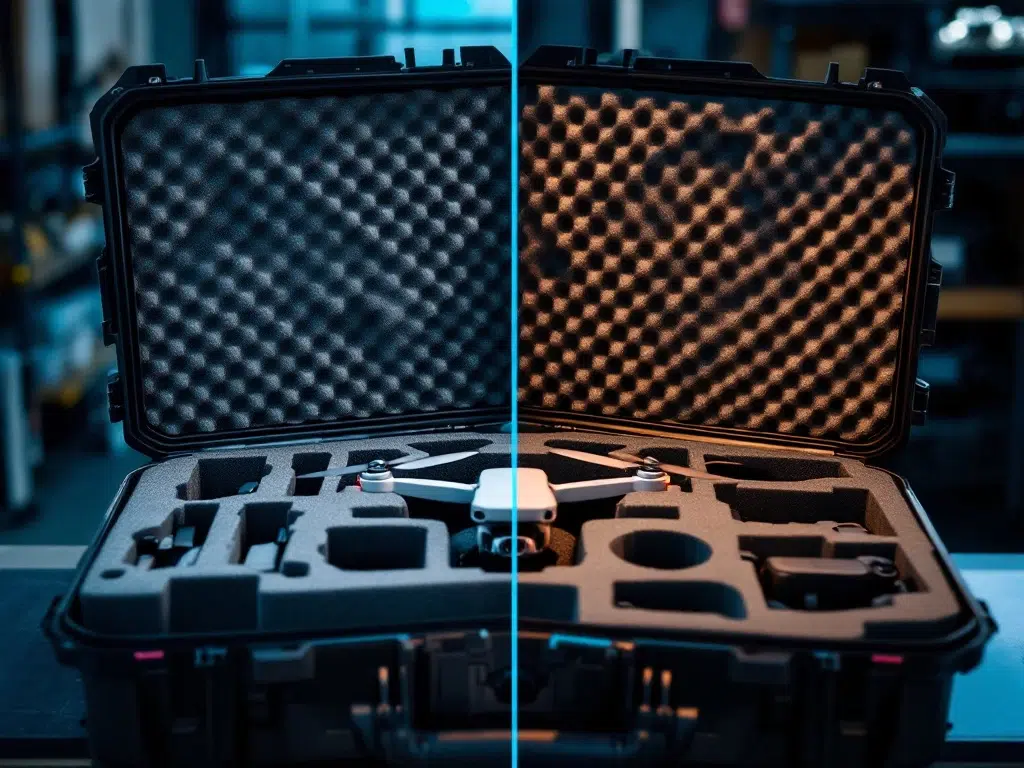
When transporting drones, proper protection is crucial to prevent damage and extend the lifespan of your valuable equipment. Foam inlays form the heart of any good drone packaging, but not all foam is equal. The perfect foam inlay protects against shocks, vibrations, and moisture, while keeping fragile components such as propellers, cameras, and electronics in place. In this article, we discuss which types of foam work best for drone protection, how to choose the right density, and why customization and water resistance are important.
Which types of foam are suitable for drone protection?
For effective drone protection, PE (polyethylene), PU (polyurethane), and EVA (ethylene vinyl acetate) foam are the most suitable materials. Each type has specific properties that provide different levels of protection for your drone.
PE foam is known for its excellent shock absorption and durability. It is chemically inert, meaning it doesn’t release harmful substances that could damage electronic components. PE foam is also water-resistant and can be compressed repeatedly without losing its shape, making it ideal for drones that are transported regularly.
PU foam is softer and more flexible than PE foam, making it excellently suited for protecting highly sensitive components such as gimbal systems and cameras. It easily forms around irregular shapes and provides superior vibration isolation. The downside is that PU foam is less water-resistant and can break down over time.
EVA foam combines the best properties of both worlds: it is lightweight yet sturdy, water-resistant, and provides excellent shock absorption. It is particularly suitable for drones used in outdoor environments where they may be exposed to moisture and extreme temperatures. EVA foam is also UV-resistant, preventing degradation from sunlight.
For professional applications, such as in the defense and security sector, combinations of these materials are often used to provide optimal protection against various types of impact and environmental factors.
How to choose the right foam density for drone packaging?
Foam density is measured in kilograms per cubic meter (kg/m³) and is a crucial factor when choosing the right protection for your drone. The optimal density depends on the weight of your drone, the vulnerability of the components, and the expected transport conditions.
For lightweight hobby drones (under 500 grams), foam with a lower density of 25-35 kg/m³ usually works sufficiently. These drones need less protection against heavy shocks, and a softer foam provides comfortable support.
Medium-weight drones (500-1500 grams) require foam with a density of 35-45 kg/m³. This density offers a good balance between shock absorption and firmness without unnecessarily adding weight to your transport case.
Professional and heavier drones (above 1500 grams) need foam with a density of 45-65 kg/m³. This higher density provides the necessary support for heavier components and better protection against strong impact during transport.
For military or industrial drones used in extreme conditions, foam with a density of 65-80 kg/m³ is recommended. This high-quality foam offers maximum protection against heavy shocks and vibrations.
Also pay attention to the compression resistance of the foam. Foam that is too soft will compress too much under the weight of the drone, while foam that is too hard provides insufficient shock absorption. The ideal foam gives slightly under pressure but returns completely to its original shape.
What are the benefits of custom-cut foam inlays?
Custom-cut foam inlays offer significant advantages over standard solutions, especially for valuable and sensitive equipment such as drones. The main benefits are:
Perfect fit for maximum protection. Every drone has a unique design with specific protruding parts such as propellers, cameras, and sensors. A custom-cut foam inlay follows the exact contours of your drone, keeping each component in place and optimally protected against movement and impact.
Targeted protection of vulnerable components. In drones, certain parts such as the gimbal, camera, and electronics are extra vulnerable. With custom foam, you can provide additional protection to these specific components by combining different densities and materials where needed.
A professional appearance that inspires confidence. For professional applications in defense, security, or emergency services, a sleek, professional presentation is important. Custom-made foam inlays not only give an organized impression but also radiate care and attention to detail.
Efficient use of space in your transport case. By precisely adapting the foam to your drone and accessories, you can use a more compact case without compromising on protection. This makes transport lighter and more manageable, which is especially important for professionals who need to transport their equipment regularly.
Faster and safer access to your equipment. With a well-designed custom foam inlay, you can see at a glance if all components are present. This is crucial for applications where time is of the essence, such as emergency services or defense operations where immediate action may be necessary.
Why choose water-resistant foam for drone transport?
Water-resistant foam is an essential choice for drone transport, especially for professional applications where drones are deployed in various environments. Protection against moisture and water offers several important benefits.
Drones contain sensitive electronics and lithium-ion batteries that can be seriously damaged when exposed to moisture. Water-resistant foam forms a barrier against condensation, rain, and humidity, significantly reducing the risk of short circuits, oxidation of contact points, and battery problems.
During transport, unexpected conditions such as rain, snow, or high humidity can occur. Water-resistant foam maintains its structural integrity and protective properties, even in damp conditions, while non-water-resistant foam can sag, deform, or break down when wet.
For applications in the security sector, defense, or emergency services, drones are often deployed in challenging environments. Water-resistant foam ensures your equipment remains protected, regardless of weather conditions on location. This is crucial for missions where reliability can be vital.
Closed-cell foam such as PE and EVA is naturally water-resistant because the cell structure prevents water from being absorbed. This type of foam is ideal for drone transport in humid environments. Open-cell foam such as some PU variants, on the other hand, absorbs moisture and is less suitable for use in wet conditions, unless specially treated with water-repellent agents.
In addition to protection against moisture, water-resistant foam also provides better resistance to mold and bacteria, benefiting the hygiene and lifespan of your packaging, especially during long-term storage or use in humid climates.
How does foam quality affect the lifespan of your drone?
The quality of the foam in your drone packaging directly influences the lifespan and reliability of your equipment. Investing in high-quality foam protection is an investment in the durability of your drone.
Protection of electronic components is one of the most important functions of quality foam. The sensitive circuit boards, processors, and sensors in modern drones can be permanently damaged by even small shocks or vibrations. High-quality foam effectively absorbs this impact, significantly reducing the chance of internal damage to electronic components.
The gimbal system, which ensures camera stabilization, is one of the most delicate and expensive parts of a drone. Quality foam keeps the gimbal system firmly in place and protects the precision motors and sensors from shocks that can disrupt accuracy or cause permanent damage.
The cameras of drones often represent a considerable portion of the device’s value. Good foam protection prevents scratches on lenses, damage to sensors, and disruption of calibration, preserving image quality throughout the lifespan of your drone.
Propellers are not only vulnerable to breakage but can also affect the flight performance and safety of the drone when damaged. Precision-cut foam keeps propellers safely in place and prevents bending or breaking during transport.
In addition to physical protection, quality foam also provides protection against environmental factors. UV-resistant and anti-static properties of premium foam prevent degradation of plastic components and protect sensitive electronics from static discharge, further extending the lifespan of your drone.
For professional applications, such as in the defense or security sector, the reliability of a drone can be of critical importance. High-quality foam protection ensures your equipment is always operational when you need it, without unexpected defects due to transport damage.
Conclusion
The right foam inlay for your drone is not a luxury but a necessity, especially for professional applications where reliability is crucial. By choosing the right type of foam (PE, PU, or EVA), with the optimal density for your specific drone, and preferably custom-cut and water-resistant, you maximize protection and extend the lifespan of your valuable equipment.
For applications in demanding sectors such as defense, security, and emergency services, it’s especially important to invest in quality foam that can withstand extreme conditions. A drone that is not operational due to transport damage can have serious consequences when deployed for critical missions.
At Faes, we understand the unique challenges of safely transporting sensitive equipment such as drones. With our expertise in industrial custom packaging for the defense sector and other demanding applications, we can help you find the perfect protection solution that meets the highest standards.
Frequently Asked Questions
How do I clean foam inlays without affecting the protective properties?
Clean PE and EVA foam with a slightly damp cloth and mild soap, avoid aggressive chemicals. Allow the foam to air dry completely before replacing your drone. For PU foam, it's better to clean only dry with a soft brush or compressed air, as this material can absorb moisture. Avoid direct sunlight during drying to prevent deformation or degradation.
What is the best solution for transporting drone accessories such as extra batteries and propellers?
Choose a foam inlay with separate compartments for accessories. For lithium-ion batteries, specific cutouts with flame-retardant properties are recommended. Propellers are best stored flat in shallow recesses to prevent deformation. Consider a modular system where the main drone and accessories are stored in different layers for optimal organization and accessibility.
How do I protect my drone during transport in extreme temperatures?
Choose foam with temperature resistance such as PE or EVA foam, which remain stable between -40°C and +80°C. Add an extra layer of thermal insulation in the case for protection against rapid temperature changes. Always allow your drone to acclimate before using it after transport in extreme temperatures, and for professional applications, consider a case with temperature-regulating properties.
Which foam is the most environmentally friendly for drone protection?
PE foam is one of the most environmentally friendly options because it is 100% recyclable and contains no harmful substances. Look for foam that is free of CFCs, HCFCs, and formaldehyde. There are also increasingly more bio-based foam alternatives coming to market that are made from plant-based materials. For the most sustainable option, choose foam with a long lifespan so replacement is needed less frequently.